
Role-based clinical workflows
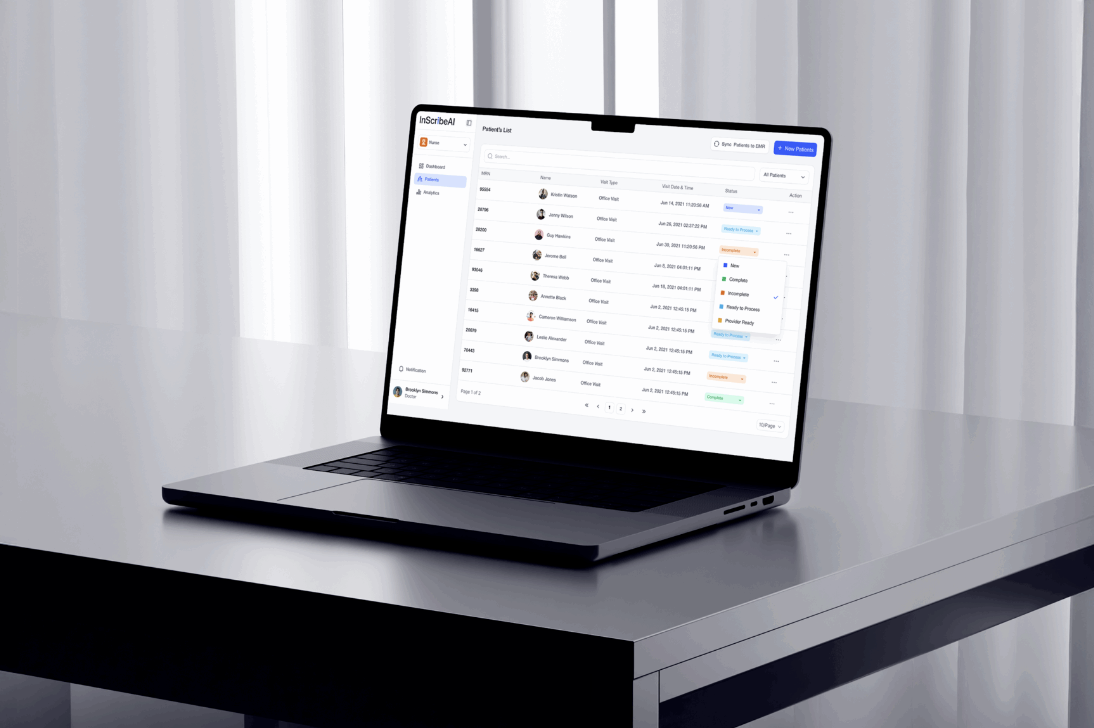
Separate nurse and doctor experiences guide intake, encounter recording, review, approval, and EHR synchronization.
Healthcare AI Case Study
A HIPAA-aware B2B SaaS platform that combines clinical speech recognition, multi-stage LLM workflows, human review, RAG, and EHR integrations.
Project Overview
SureScribe automates clinical documentation workflows performed by nurses and general practitioners in EHR systems such as Athenahealth and CharmHealth.
The platform captures patient encounters, creates structured clinical notes, supports voice-driven corrections, and lets clinicians review every AI-refined field before approved information is synchronized to the EHR.
Business Challenge
Transcribe overlapping speech, medical terminology, and multiple speakers in noisy clinical environments.
Design multi-stage prompts that convert conversational transcripts into accurate, tab-specific clinical documentation.
Give clinicians transparency and final control over AI-generated content before EHR synchronization.
Protect PHI through encryption, appropriate vendor agreements, access controls, and automated data deletion.
Our Solution
The system combines AssemblyAI and other speech-to-text research with ChatGPT and LangChain pipelines that refine transcripts into structured clinical sections such as intake summaries, HPI, orders, medications, labs, and procedures.
A side-by-side raw and refined experience, explicit approval checkpoints, and voice corrections keep clinicians in control. RAG-based document chat retrieves relevant patient-record context while limiting the information sent to the model.
Key Features
Separate nurse and doctor experiences guide intake, encounter recording, review, approval, and EHR synchronization.
Tab-specific prompt pipelines transform clinical conversations into editable, structured documentation.
Clinicians compare raw and refined content, make voice or text corrections, and approve data before it reaches the EHR.
Clinicians can ask natural-language questions about selected medical reports using grounded, token-efficient retrieval.
Patient registrations, reports, lab results, and approved structured notes move through connected EHR workflows.
Encryption, controlled access, vendor safeguards, and PHI lifecycle decisions support healthcare privacy requirements.
Technologies Used
Results & Impact
The designed workflow reduced documentation from more than an hour to approximately 20 minutes per patient.
Raw-versus-refined views, correction tools, and final approval keep clinicians accountable for the official record.
Integrated reports and grounded document chat help clinicians find medications, lab results, and relevant context faster.
CustomSoftware DevelopmentCompany
Talk with an experienced software team about your goals, workflows, users, integrations, and technical risks before you commit to a roadmap, architecture, or development budget.