The current app works
Staff are trained, workflows are settled and a rebuild would disrupt care for months.
Add an AI Scribe to Existing EHR Software
You already have working software. We add ambient recording, AI-drafted notes, clinician approval and write-back to it, so your team gets AI documentation without a rebuild or a platform switch.
What Is This Service?
Many clinics, treatment programs and health-tech companies have an application that works: clinicians know it, data lives in it, and reports depend on it. What it lacks is an AI recorder that turns a conversation into the note or form the clinician would otherwise type.
Replacing that software to get AI is expensive and risky. Our service adds the AI layer to what you have: audio capture inside your current app, a pipeline that turns the conversation into structured drafts in your formats, a review screen where clinicians edit and approve, and write-back to your existing database or EHR.
We built these same pieces for SureScribe, including write-back to Athenahealth and CharmHealth, where documentation dropped from more than an hour to about 20 minutes per patient.
Business Challenges
Staff are trained, workflows are settled and a rebuild would disrupt care for months.
Years of records, billing and compliance reporting depend on the existing data model.
Generic scribes produce generic notes and rarely write into custom forms or niche EHRs.
A focused AI addition costs less and can be piloted with a few clinicians before wider rollout.
Features & Capabilities
A record button on web or mobile, with consent prompts, pause and resume, and secure upload, added to your existing screens.
Speech engines benchmarked on your sessions, with speaker separation and clinical vocabulary.
Multi-stage AI that fills your note sections or form fields as drafts, following your templates rather than a generic format.
Side-by-side transcript and draft, inline edits, and explicit approval before anything is saved.
Approved content is written to your database or EHR through its APIs, so the record of truth stays where it is today.
Encryption, role-based access, audit logs and defined retention for audio and transcripts.
Business Benefits
Your data, forms, integrations and reports stay exactly where they are.
A proof of concept on one workflow in about four weeks, before any larger commitment.
Clinicians keep the screens they know; the AI appears as a helper inside them.
The AI layer is part of your product, configured to your templates and vendors.
Our Process
We review your application, tech stack, data model, target notes or forms and integration points, and agree what success looks like.
We add recording to your current app, including consent and failure handling for poor connectivity.
We build transcription and the multi-stage prompts that produce drafts in your formats, with an evaluation set.
We add review, edit and approve screens that fit your existing interface.
Approved content is saved to your database or EHR, with audit history.
A pilot group uses it in real work; we measure, fix and then expand.
Technologies We Use
We work with your existing stack and add only what the AI layer needs. Model and speech providers are chosen by measured results on your data.
Who It's For
Assessment and session documentation added to an existing app or EHR.
Custom or niche EHRs that generic scribes do not write into.
Visit notes captured in the field app caregivers already use.
Product teams adding ambient documentation to their own platform.
Why Torch Solutions
Capture, multi-stage notes, clinician approval and EHR write-back, all shipped in SureScribe.
We work inside existing web, mobile and backend codebases and alongside your developers or vendor.
A scoped proof of concept shows real results before you commit to a full integration.
PHI flows, vendor agreements, access and retention are designed before the first recording.
Related Case Studies
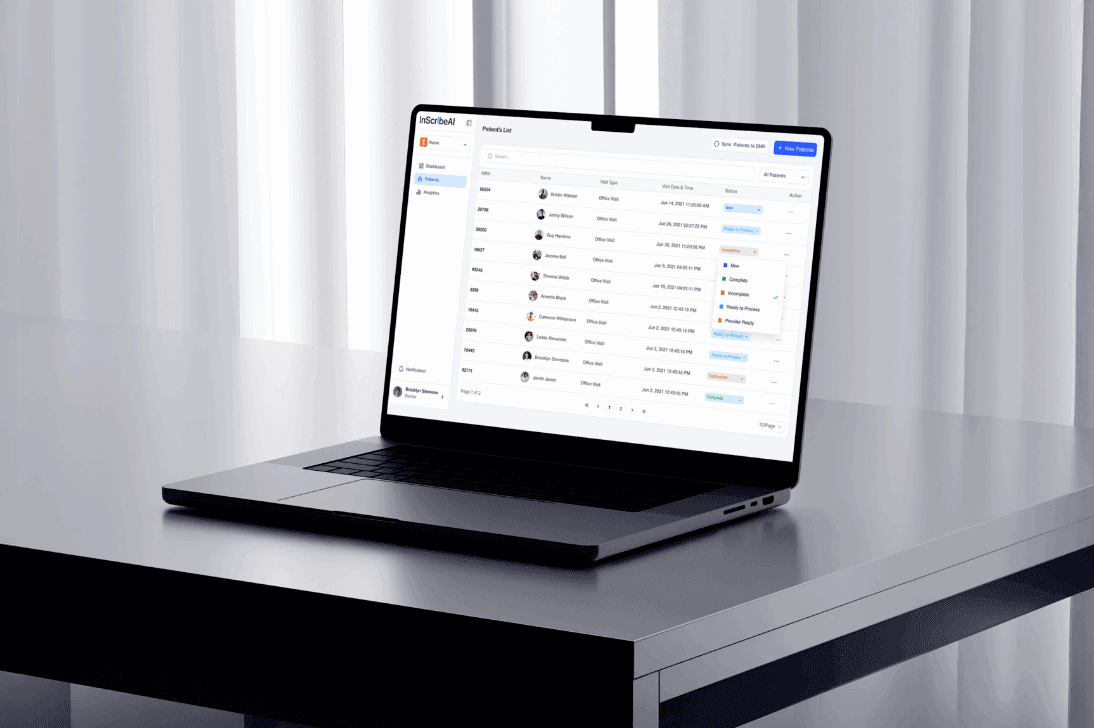
HIPAA-aware AI scribe: clinical speech recognition, multi-stage LLM notes, clinician approval and Athenahealth / CharmHealth integration. Documentation cut from 60+ to about 20 minutes per patient.
Read Case Study →Engagement & Timelines
Scoped to your application and one or two workflows first.
About 1–2 weeks
Codebase and integration review, target workflow and success criteria.
About 4 weeks
Recording to approved draft for one note type or form.
Typically 4–8 weeks
Built into your app with write-back, then piloted with clinicians.
Timelines depend on access to your codebase or vendor, available APIs and the number of note types.
Combine this capability with the application, cloud, data, integration, and product engineering required to operate it reliably.
Frequently Asked Questions
Usually, yes. We need access to the source code, or to APIs or extension points the vendor provides. During discovery we confirm which route is possible and what the vendor must support.
That is common. Recording can be added to most web applications in the browser, with the AI pipeline running as a separate secure service that your app calls.
As little as possible. They stay in the screens they know, press record, then review and approve a draft instead of typing it. Existing forms and workflows are preserved.
That is your decision. We design where audio and transcripts are processed and stored, which vendors receive them under appropriate agreements, and when they are deleted.
A subscription gives you the vendor's note formats and integrations. Adding AI to your app gives drafts in your own forms, written into your own system, with control over vendors and data.
Cost depends on your application, the number of note types or forms and integration depth. We provide a written estimate after discovery.
Have working software and want AI added to it? Contact Torch Solutions.
CustomSoftware DevelopmentCompany
Talk with an experienced software team about your goals, workflows, users, integrations, and technical risks before you commit to a roadmap, architecture, or development budget.